Filter by
Production and productivity in the European Union
In a somewhat simplified analysis of the economy, the economic system can be broken down into two main parts: on one side the enterprise 'operators', producing goods and services, providing employment and distributing income in the form of wages; on the other the household operators, receiving income and consuming goods and services. The other operators in the economic system are the genera…
- Edition
- -
- ISBN/ISSN
- 92-828-9605-6
- Collation
- 1-66
- Series Title
- -
- Call Number
- -

Risk Management: The Current Financial Crisis, Lessons Learned and Future Imp…
Many people believe that excessive risk taking at large financial firms was an important cause of the financial crisis of 2007–2008 and that preventing another crisis requires improving risk-management systems at such institutions. One way to do this would be to use board oversight liability to hold directors personally liable for failing to properly monitor the risks that their firms are run…
- Edition
- -
- ISBN/ISSN
- -
- Collation
- 1-78
- Series Title
- -
- Call Number
- -

Risk Management: The Current Financial Crisis, Lessons Learned and Future Imp…
- Edition
- -
- ISBN/ISSN
- -
- Collation
- 1-104
- Series Title
- -
- Call Number
- -
- Edition
- -
- ISBN/ISSN
- -
- Collation
- 1-104
- Series Title
- -
- Call Number
- -
The Foundations of Business
- Edition
- -
- ISBN/ISSN
- -
- Collation
- 1-940
- Series Title
- -
- Call Number
- -
- Edition
- -
- ISBN/ISSN
- -
- Collation
- 1-940
- Series Title
- -
- Call Number
- -
INTRODUCTION TO HUMAN RESOURCE MANAGEMENT AND ENVIRONMENT
Human Resource Management (HRM) is a relatively new approach to managing people in any organisation. People are considered the key resource in this approach. it is concerned with the people dimension in management of an organisation. Since an organisation is a body of people, their acquisition, development of skills, motivation for higher levels of attainments, as well as ensuring maintenance o…
- Edition
- -
- ISBN/ISSN
- -
- Collation
- 1-151
- Series Title
- -
- Call Number
- -
Risk Management 2013
- Edition
- -
- ISBN/ISSN
- -
- Collation
- 1-110
- Series Title
- -
- Call Number
- -
- Edition
- -
- ISBN/ISSN
- -
- Collation
- 1-110
- Series Title
- -
- Call Number
- -
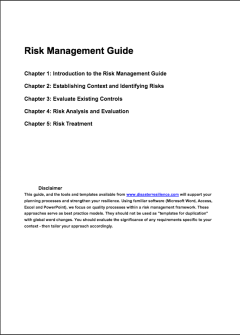
Risk Management Guide
This guide, and the tools and templates available from www.disasterresilience.comwill support your planning processes and strengthen your resilience. Using familiar software (Microsoft Word, Access,Excel and PowerPoint), we focus on quality processes within a risk management framework. These approaches serve as best practice models. They should not be used as "templates for duplication"with glo…
- Edition
- -
- ISBN/ISSN
- -
- Collation
- 1-19
- Series Title
- -
- Call Number
- -

Introduction to Business and Management Research
- Edition
- -
- ISBN/ISSN
- -
- Collation
- -
- Series Title
- -
- Call Number
- -
- Edition
- -
- ISBN/ISSN
- -
- Collation
- -
- Series Title
- -
- Call Number
- -
Market Risk and Model Risk For a Financial Institution Writing Options
Trading in derivatives involves heavy use of quantitative models for valuation and risk management. These models are necessarily imperfect, and when options are involved, the models require a volatility input that must be forecasted, subject to error. This creates “model risk” to which nearly all participants in derivatives markets are exposed. In this paper, we conduct an empirical sim…
- Edition
- -
- ISBN/ISSN
- -
- Collation
- -
- Series Title
- -
- Call Number
- -
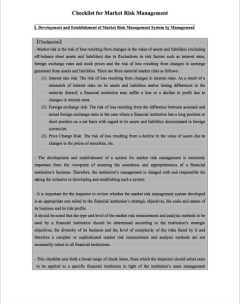
Checklist for Market Risk Management
- Edition
- -
- ISBN/ISSN
- -
- Collation
- 1-42
- Series Title
- -
- Call Number
- -
- Edition
- -
- ISBN/ISSN
- -
- Collation
- 1-42
- Series Title
- -
- Call Number
- -

Management: Science, Theory and Practice
One of the most important human activities is managing. Ever since people began forming groups to accomplish aims they could not achieve as individuals, managing has been essential to ensure the coordination of individual efforts. As society has come to rely increasingly on group effort and as many organized groups have grown larger, the task of mangers has been in importance. The purpose of th…
- Edition
- -
- ISBN/ISSN
- -
- Collation
- 1-13
- Series Title
- -
- Call Number
- -
STATISTICS FOR BUSINESS AND ECONOMICS 11e
The purpose of STATISTICS FOR BUSINESS AND ECONOMICS is to give students, pri- marily those in the fields of business administration and economics, a conceptual introduc- tion to the field of statistics and its many applications. The text is applications oriented and written with the needs of the nonmathematician in mind; the mathematical prerequisite is knowledge of algebra. Applications of da…
- Edition
- Second Edition
- ISBN/ISSN
- 978-0-324-78325-4
- Collation
- 1-1114
- Series Title
- -
- Call Number
- -

Business statistics with Excel and Tableau A hands-on guide with screencasts…
I began business life as an entrepreneur in business in Hong Kong. I ran trade exhibitions, imported coffee from Kenya, and started and operated two restaurants, one of which (unusually for Hong Kong) served vegetarian food. These businesses were profitable, but I would have saved myself a great deal of stress, and done better if I had used some business intelligence informed by statistics to i…
- Edition
- -
- ISBN/ISSN
- -
- Collation
- 1-247
- Series Title
- -
- Call Number
- -

Human resource management
This subject guide is about human resource management (HRM). This is the management activity taken by commercial firms, state owned enterprises and other organisations to recruit, retain and motivate their employees. In other words HRM is the bundle of policies, programmes and plans which organisations adopt with the objective of making full use of the people they employ. These includ…
- Edition
- -
- ISBN/ISSN
- -
- Collation
- 1-66
- Series Title
- -
- Call Number
- -
Statistics:The Exploration and Analysis of Data
- Edition
- 7th edition
- ISBN/ISSN
- 978-0-8400-5801-0
- Collation
- -
- Series Title
- Statistics:The Exploration and Analysis of Data
- Call Number
- -
- Edition
- 7th edition
- ISBN/ISSN
- 978-0-8400-5801-0
- Collation
- -
- Series Title
- Statistics:The Exploration and Analysis of Data
- Call Number
- -
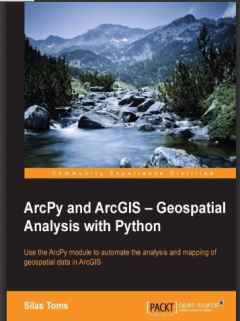
DATABASE MANAGEMENT SYSTEMS
Database Management System (DBSM) are an intetgrated and crucial component of most successful GIS. DBMS are used to store, manipulate and retrieve data from a database. A key element in creating a spatial database design using a variety of data modelling techniques. Although the range of DBMS structures used in GIS includes inverted list, hierarchical, network and relational designs, it is the…
- Edition
- -
- ISBN/ISSN
- -
- Collation
- 1-17
- Series Title
- -
- Call Number
- -
STATISTICS FOR THE LIFE SCIENCES
- Edition
- 4th edition
- ISBN/ISSN
- 978-0-321-65280-5
- Collation
- -
- Series Title
- STATISTICS FOR THE LIFE SCIENCES
- Call Number
- -
- Edition
- 4th edition
- ISBN/ISSN
- 978-0-321-65280-5
- Collation
- -
- Series Title
- STATISTICS FOR THE LIFE SCIENCES
- Call Number
- -
Summary Minutes of the Working Group (WG) Meeting "Harmonization of Consume…
The Econometric Study and Model to Estimate Land Prices undertaken by an external contractor on behalf of Eurostat showed that a separation of the land price part from the structure part was not feasible from the data at hand. Notwithstanding the traditional partition to land and structure becomes less clear depending on the allocation of the location variables. More conceptual work and a furth…
- Edition
- -
- ISBN/ISSN
- -
- Collation
- 1-3
- Series Title
- -
- Call Number
- -
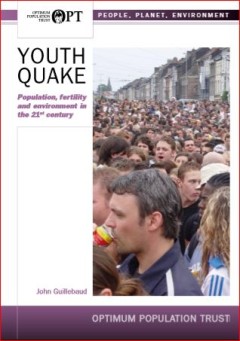
YOUTH QUAKE Population, fertility and environment in the 21st century
The earth faces a future of rising populations and growing strains on the planet . Whatever else the future holds, significant population increase is inevitable and the current UN forecast of 9 .2 billion by 2050 – itself a 40 per cent increase on the 6 .7 billion in 2007 – may turn out to be an underestimate . The environmental damage resulting from population increase is already widesprea…
- Edition
- -
- ISBN/ISSN
- -
- Collation
- 1-28
- Series Title
- -
- Call Number
- -
YOUTH QUAKE Population, fertility and environment in the 21st century
The earth faces a future of rising populations and growing strains on the planet . Whatever else the future holds, significant population increase is inevitable and the current UN forecast of 9 .2 billion by 2050 – itself a 40 per cent increase on the 6 .7 billion in 2007 – may turn out to be an underestimate . The environmental damage resulting from population increase is already widesprea…
- Edition
- -
- ISBN/ISSN
- -
- Collation
- 1-28
- Series Title
- -
- Call Number
- -
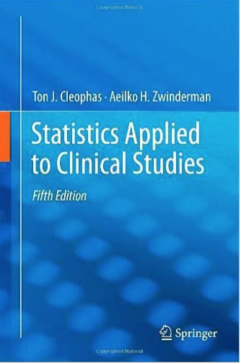
Statistics Applied to Clinical Studies
- Edition
- 5th edition
- ISBN/ISSN
- 978-94-007-2862-2
- Collation
- -
- Series Title
- Statistics Applied to Clinical Studies
- Call Number
- -
- Edition
- 5th edition
- ISBN/ISSN
- 978-94-007-2862-2
- Collation
- -
- Series Title
- Statistics Applied to Clinical Studies
- Call Number
- -
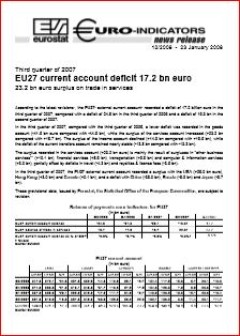
Third quarter of 2007 EU27 current account deficit 17.2 bn euro 23.2 bn euro …
According to the latest revisions1, the EU272 external current account3 recorded a deficit of 17.2 billion euro in the third quarter of 2007, compared with a deficit of 24.6 bn in the third quarter of 2006 and a deficit of 16.3 bn in the second quarter of 2007. In the third quarter of 2007, compared with the third quarter of 2006, a lower deficit was recorded in the goods account (-41.5 bn eu…
- Edition
- -
- ISBN/ISSN
- -
- Collation
- 1-6
- Series Title
- -
- Call Number
- -
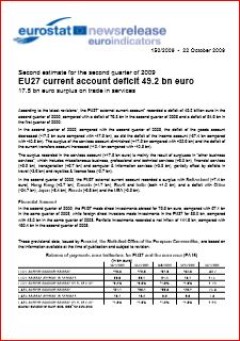
Second estimate for the second quarter of 2009 EU27 current account deficit 4…
In the second quarter of 2009, compared with the second quarter of 2008, the deficit of the goods account decreased (-17.2 bn euro compared with -47.5 bn), as did the deficit of the income account (-37.4 bn compared with -40.8 bn). The surplus of the services account diminished (+17.5 bn compared with +22.6 bn) and the deficit of the current transfers account increased (-12.1 bn compared with -…
- Edition
- -
- ISBN/ISSN
- -
- Collation
- 1-5
- Series Title
- -
- Call Number
- -
How to Write Letters
- Edition
- -
- ISBN/ISSN
- -
- Collation
- -
- Series Title
- -
- Call Number
- -
- Edition
- -
- ISBN/ISSN
- -
- Collation
- -
- Series Title
- -
- Call Number
- -
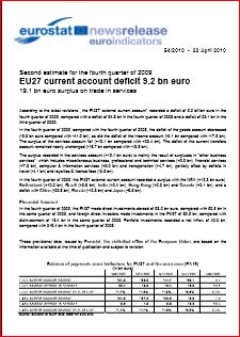
Second estimate for the fourth quarter of 2009 EU27 current account deficit 9…
According to the latest revisions1, the EU272 external current account3 recorded a deficit of 9.2 billion euro in the fourth quarter of 2009, compared with a deficit of 54.8 bn in the fourth quarter of 2008 and a deficit of 23.1 bn in the third quarter of 2009.
- Edition
- -
- ISBN/ISSN
- -
- Collation
- 1-5
- Series Title
- -
- Call Number
- -
Probability & Statistics for Engineers & Scientists
- Edition
- -
- ISBN/ISSN
- 978-0-321-62911-1
- Collation
- -
- Series Title
- Probability & Statistics for Engineers & Scientists
- Call Number
- -
- Edition
- -
- ISBN/ISSN
- 978-0-321-62911-1
- Collation
- -
- Series Title
- Probability & Statistics for Engineers & Scientists
- Call Number
- -
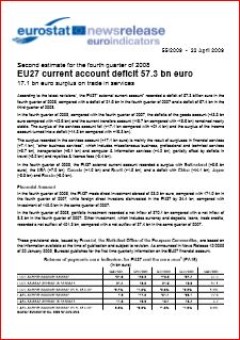
Second estimate for the fourth quarter of 2008 EU27 current account deficit 5…
According to the latest revisions1, the EU272 external current account3 recorded a deficit of 57.3 billion euro in the fourth quarter of 2008, compared with a deficit of 21.6 bn in the fourth quarter of 2007 and a deficit of 67.4 bn in the third quarter of 2008.
- Edition
- -
- ISBN/ISSN
- -
- Collation
- 1-5
- Series Title
- -
- Call Number
- -

Crime and Punishment
- Edition
- -
- ISBN/ISSN
- -
- Collation
- -
- Series Title
- -
- Call Number
- -
- Edition
- -
- ISBN/ISSN
- -
- Collation
- -
- Series Title
- -
- Call Number
- -

Banking: An Introduction
- Edition
- 1st Edition
- ISBN/ISSN
- 9788740305968
- Collation
- -
- Series Title
- Banking: An Introduction
- Call Number
- -
- Edition
- 1st Edition
- ISBN/ISSN
- 9788740305968
- Collation
- -
- Series Title
- Banking: An Introduction
- Call Number
- -

Time Management for Creative People
- Edition
- -
- ISBN/ISSN
- -
- Collation
- -
- Series Title
- -
- Call Number
- -
- Edition
- -
- ISBN/ISSN
- -
- Collation
- -
- Series Title
- -
- Call Number
- -
 Computer Science, Information & General Works
  Philosophy & Psychology
  Religion
  Social Sciences
  Language
  Pure Science
  Applied Sciences
  Art & Recreation
  Literature
  History & Geography