Filter by
Case Study: an Information System Management Model
This article presents the purchase management information system, finance management information system and security information system, their interdependence and tight correlation. Furthermore, we state the goals of the purchase management information system that must be achieved in any organisation, as the purchase (sub)process is carried out in every organisation. P-K matrix gives a deta…
- Edition
- -
- ISBN/ISSN
- -
- Collation
- 1-12
- Series Title
- Case Study: an Information System Management Model
- Call Number
- -
MANAGEMENT INFORMATION SYSTEM
A Management Information System is an integrated user-machine system, for providing information, to support the operations, management, analysis & decision-making functions in an organization
- Edition
- -
- ISBN/ISSN
- -
- Collation
- 1-30
- Series Title
- MANAGEMENT INFORMATION SYSTEM
- Call Number
- -
COMPUTER-BASED MANAGEMENT INFORMATION SYSTEM MODEL AT HIGHER EDUCATION INSTIT…
Globalization and decentralization have given impact to all systems including the situation for qualified decision making at Higher Education (HE) Institution, therefore data or information from management information system (MIS) that run well is required. For this purpose, there are several things required: 1) MIS that adaptive, dynamic, integrative, comprehensive and strategic in supporting…
- Edition
- -
- ISBN/ISSN
- -
- Collation
- 1-12
- Series Title
- COMPUTER-BASED MANAGEMENT INFORMATION SYSTEM MODEL AT HIGHER EDUCATION INSTITUTION
- Call Number
- -

E-Learning and Management Information Systems For E-Universities
During our work as supervisors in Faculty of Computers and Information Sciences in Mansoura University, Egypt, we were really frustrated with the number of graduation projects entitled or include “E-Learning” leading to the spread of a type of E-Learning graduation projects that focuses on the managerial aspects of the “University”, and abstracting the learning process in the uploadi…
- Edition
- -
- ISBN/ISSN
- 978-960-474-099-4
- Collation
- 1-11
- Series Title
- E-Learning and Management Information Systems For E-Universities
- Call Number
- -

PROJECT MANAGEMENT INFORMATION SYSTEMS
CARE is a rich organization in information resources, our program activities produce every day a wealth of information on every aspect of our work. We are by essence an organization that creates vast amounts of data, information and knowledge. We are an organization rich in methodologies, practices, implementation strategies, work methods and experiences. But at the same time we are a poo…
- Edition
- -
- ISBN/ISSN
- -
- Collation
- 1-190
- Series Title
- PROJECT MANAGEMENT INFORMATION SYSTEMS
- Call Number
- -

Education Management Information System: A Short Case Study of Ghana
EMIS design in Ghana is an example of best practice for decentralised planning and budgeting, supporting reforms at various levels but challenges remain for successful implementation, notably in commitment, capacity development and dissemination. EMIS plays an important role in policy formulation, operational planning and subsequent monitoring of targets through periodic review although sta…
- Edition
- -
- ISBN/ISSN
- -
- Collation
- 1-24
- Series Title
- Education Management Information System: A Short Case Study of Ghana
- Call Number
- -
Management Information System: Information Needs of Organization
In present era of information technology where information is not considered as base for competitive advantage but it is considered as competitive necessity, role of information in decision making become more vital. In this article author discuss about the introduction, nature and types of information in organizations. How information requirements in organizations could be determined analy…
- Edition
- -
- ISBN/ISSN
- 0974-2239
- Collation
- 1-6
- Series Title
- Management Information System: Information Needs of Organization
- Call Number
- -
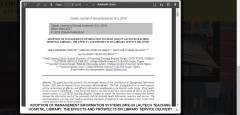
ADOPTION OF MANAGEMENT INFORMATION SYSTEMS (MIS) IN LAUTECH TEACHING HOSPITAL…
This paper describes primarily the advantages abound in the introduction of Management Information Systems (MIS) into the hospital library information service delivery. The ‘tool’ if adopted will in no small measure aid the achievement of effective and efficient information management in the hospital under review. Using health systems research methodology, it was found that there is the nee…
- Edition
- -
- ISBN/ISSN
- 1943-2577
- Collation
- 1-10
- Series Title
- ADOPTION OF MANAGEMENT INFORMATION SYSTEMS (MIS) IN LAUTECH TEACHING HOSPITAL LIBRARY: THE EFFECTS AND PROSPECTS ON LIBRARY SERVICE DELIVERY
- Call Number
- -
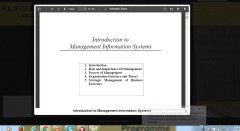
Introduction to Management Information Systems
The concept of the MIS has evolved over a period of time comprising many different facets of the organizational function. MIS is a necessity of all the organizations. The initial concept of MIS was to process data from the organization and present it in the for of reports at regular intervals. The system was largely capable of handling the data from collection to processing. It was more imp…
- Edition
- -
- ISBN/ISSN
- -
- Collation
- 1-193
- Series Title
- Introduction to Management Information Systems
- Call Number
- -
MANAGEMENT INFORMATION SYSTEMS
Management Information System is an old management tool, which has been long used by people for better management and scientific decision-making. Management Information System is mainly dependent upon information, which is a vital ingredient of any Management Information System. Information is the most critical resource of Management Information System. We all know that information is a vit…
- Edition
- -
- ISBN/ISSN
- -
- Collation
- 1-272
- Series Title
- MANAGEMENT INFORMATION SYSTEMS
- Call Number
- -
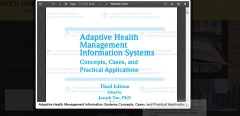
Adaptive Health Management Information Systems Concepts, Cases, and Practical…
Adaptive Health Management Information Systems, Third Edition, is for instructors who want to keep pace with rapid changes in the field of healthcare management information systems (HMIS) and health informatics (HI). This new edition is not simply an update of the second edition—it is a completely reorganized, expanded, and rewritten text containing all new con- tributions, special sections,…
- Edition
- 3RD EDITION
- ISBN/ISSN
- -
- Collation
- 1-41
- Series Title
- Adaptive Health Management Information SystemsConcepts, Cases, and Practical Applications
- Call Number
- -

Project Management for Information Systems
We are very pleased to present this fifth edition of Project Management for Information Systems. As with its predecessors, our ‘target audience’ fall into four groups: IS project managers and systems developers who find themselves responsible for managing systems projects. Newcomers to this activity will find much that will be of help to them; and we also hope that older hands will find som…
- Edition
- -
- ISBN/ISSN
- 978-0-13-206858-1
- Collation
- 1-465
- Series Title
- Project Management for Information Systems
- Call Number
- -

Information Security Management System
Information is an important value to companies and government agencies, and must therefore be protected appropriately. Most information today is created, stored, transported, or processed at least in part using information technology (IT). In the industry and administrations, no one denies the necessity to adequately protect its IT landscape. In addition, though, information from all other p…
- Edition
- -
- ISBN/ISSN
- -
- Collation
- 1-38
- Series Title
- Information Security Management System
- Call Number
- -
The Use of Management Information Systems (MIS) In Decision Making In The Sou…
This study investigated the use of Management Information Systems (MIS) in decision-making on longterm planning, short-term planning and budgeting in the South-West Nigerian Universities. The study used the descriptive research design of the survey type. Data were collected from a sample of 600 subjects consisting of 400 academic staff holding administrative staff positions and 200 senior a…
- Edition
- -
- ISBN/ISSN
- 1990-3839
- Collation
- 1-8
- Series Title
- The Use of Management Information Systems (MIS) In Decision Making In The South-West Nigerian Universities
- Call Number
- -

A Guide to Establishing Management Information System in Tertiary Institution…
Information is data that have been put into a meaningful and useful context and communicated to a recipient who uses it to make decisions. Information involves the communication and reception of intelligence or knowledge. It appraises and notifies surprises and stimulates, reduces uncertainty, reveals additional alternatives or helps eliminate irrelevant or poor ones and influences individua…
- Edition
- -
- ISBN/ISSN
- 2079-2034
- Collation
- 1-6
- Series Title
- A Guide to Establishing Management Information System in Tertiary Institutions in Nigeria
- Call Number
- -
Management Information Systems And Corporate Decision– Making: A Literature…
Information has become an essential resource for managing modern organizations. This is so because today’s business environment is volatile, dynamic, turbulent and necessitates the burgeoning demand for accurate, relevant, complete, timely and economical information needed to drive the decision-making process in order to accentuate organizational abilities to manage opportunities and threats …
- Edition
- -
- ISBN/ISSN
- -
- Collation
- 1-5
- Series Title
- Management Information Systems And Corporate Decision– Making: A Literature Review
- Call Number
- -
The Role of Management Support Systems (MSSs) for Manager’s effective Decis…
In today‟s world of ever-increasing complexities of business as well as management, every business organization, in order to survive and grow, must have a properly planned, analyzed, designed and maintained Management Information System (MIS) so that it provides timely, reliable and useful information to enable the management to take speedy, effective and rational decisions. There are varieti…
- Edition
- -
- ISBN/ISSN
- 0976-8602
- Collation
- 1-5
- Series Title
- The Role of Management Support Systems (MSSs) for Manager’s effective Decision Making Process : An Overview
- Call Number
- -
THE SIGNIFICANCE OF MANAGEMENT INFORMATION SYSTEMS FOR ENHANCING STRATEGIC AN…
Management Information Systems (MIS) is the key factor to facilitate and attain efficient decision making in an organization. This research explores the extent to which management information systems implemented to make successful decisions at two selected financial organizations. The research examined whether the selected financial institutions of Bahrain vary as to the use of Management I…
- Edition
- -
- ISBN/ISSN
- 1807-1775
- Collation
- 1-12
- Series Title
- THE SIGNIFICANCE OF MANAGEMENT INFORMATION SYSTEMS FOR ENHANCING STRATEGIC AND TACTICAL PLANNING
- Call Number
- -
Management Information Systems Cases
This appendix presents several case studies that illustrate various problems that arise in MIS. They are based on publically available information regarding different organizations. It might be nice to have additional inside information, but this level of detail is rarely available to students (and teachers). Instead, most of these cases look at larger problems over time—which provides useful…
- Edition
- -
- ISBN/ISSN
- -
- Collation
- 1-116
- Series Title
- Management Information Systems Cases
- Call Number
- -
MANAGEMENT INFORMATION FOR THE ELECTRONIC LIBRARY (MIEL) PROGRAMME
The Management Information Systems and Performance Measurement for the Electronic Library project was part-funded by JISC under the Electronic Libraries Programme (eLib) as a Supporting Study. The contractor, the Centre for Research in Library & Information Management at the University of Central Lancashire, undertook the work as part of its Management Information for the Electronic Library…
- Edition
- -
- ISBN/ISSN
- -
- Collation
- 1-94
- Series Title
- MANAGEMENT INFORMATION FOR THE ELECTRONICLIBRARY (MIEL) PROGRAMME
- Call Number
- -
INFRASTRUCTURE MANAGEMENT INFORMATION SYSTEM
A geographic information system (GIS) is a technology that combines database management with digital mapping on a computer (Korte 1994). Users are able to query the database and have the results displayed on a map or obtain detailed information about objects displayed on the map with the click of a mouse button. Relationships between different types of data can be easily understood, display…
- Edition
- -
- ISBN/ISSN
- -
- Collation
- 1-17
- Series Title
- INFRASTRUCTURE MANAGEMENT INFORMATION SYSTEM
- Call Number
- -
From Information Management to Knowledge Management: Beyond the 'Hi-Tech Hide…
Most extant knowledge management systems are constrained by their overly rational, static and acontextual view of knowledge. Effectiveness of such systems is constrained by the rapid and discontinuous change that characterizes new organizational environments. The prevailing knowledge management paradigm limits itself by its emphasis on convergence and consensus-oriented processing of informatio…
- Edition
- -
- ISBN/ISSN
- -
- Collation
- 1-32
- Series Title
- From Information Management to Knowledge Management: Beyond the 'Hi-Tech Hidebound' Systems
- Call Number
- -
An Introduction to Information System Risk Management
The fundamental precept of information security is to support the mission of the organization. All organizations are exposed to uncertainties, some of which impact the organization in a negative manner. In order to support the organization, IT security professionals must be able to help their organizations’ management understand and manage these uncertainties
- Edition
- -
- ISBN/ISSN
- -
- Collation
- 1-18
- Series Title
- An Introduction to Information System Risk Management
- Call Number
- -

MANAGEMENT INFORMATION SYSTEM
We are in the midst of a swiftly moving river of technology and business innovations that is transforming the global business landscape. An entirely new Internet business culture is emerging with profound implications for the conduct of business. You can see this every day by observing how business people work using high-speed Internet connections for e-mail and information gathering, portable …
- Edition
- -
- ISBN/ISSN
- -
- Collation
- 1-54
- Series Title
- MANAGEMENT INFORMATION SYSTEM
- Call Number
- -
MANAGEMENT INFORMATION SYSTEM
The business application of Management Information System has expanded significantly over the years. Technology advances have increased both the availability and volume of information for managers and the decision makers for both planning and execution. Decision makers require information to assess and monitor performance at all levels of the organisation. The new role focused on developing bus…
- Edition
- -
- ISBN/ISSN
- 2249-0558
- Collation
- 1-18
- Series Title
- MANAGEMENT INFORMATION SYSTEM
- Call Number
- -

Information System Analysis and Designs
Information systems are vital to business. Information Systems Analysis and Design is one of the core courses in the MIS curriculum. It explains the right process of information systems development for the organization. The course also introduces the tools that can be applied to the information systems development. In the digital era, information technology has become a commodity, and the Infor…
- Edition
- -
- ISBN/ISSN
- 978-1-61233-075-4
- Collation
- -
- Series Title
- Information System Analysis and Designs
- Call Number
- -
Management Information System
- Edition
- -
- ISBN/ISSN
- -
- Collation
- -
- Series Title
- Management Information System
- Call Number
- -
- Edition
- -
- ISBN/ISSN
- -
- Collation
- -
- Series Title
- Management Information System
- Call Number
- -
MIS Concepts & Design
- Edition
- -
- ISBN/ISSN
- -
- Collation
- -
- Series Title
- MIS Concepts & Design
- Call Number
- -
- Edition
- -
- ISBN/ISSN
- -
- Collation
- -
- Series Title
- MIS Concepts & Design
- Call Number
- -
Essentials of Systems Analysis and Design
The key to success in business is the ability to gather, organize, and interpret information. Systems analysis and design is a proven methodology that helps both large and small businesses reap the rewards of utilizing information to its full capacity. As a systems analyst, the person in the organization most involved with systems analysis and design, you will enjoy a rich career path t…
- Edition
- -
- ISBN/ISSN
- -
- Collation
- -
- Series Title
- Essentials of Systems Analysis and Design
- Call Number
- -
MANAGING INFORMATION SYSTEMS: A PRACTICAL ASSESSMENT TOOL
This Assessment Tool, which provides an evaluative framework and a checklist, has been developed by the Information Technology Resources Board (ITRB) to assist Federal government organizations in gaining a better understanding of how to strategically apply information technology to achieve their missions and deliver services and products. Mission performance and service delivery are to…
- Edition
- -
- ISBN/ISSN
- -
- Collation
- -
- Series Title
- MANAGING INFORMATION SYSTEMS: A PRACTICAL ASSESSMENT TOOL
- Call Number
- -
 Computer Science, Information & General Works
  Philosophy & Psychology
  Religion
  Social Sciences
  Language
  Pure Science
  Applied Sciences
  Art & Recreation
  Literature
  History & Geography