Management
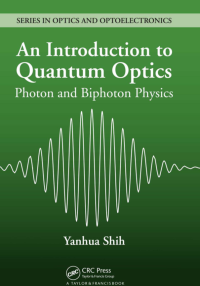
An Introduction to Quantum Optics
This book is a selected collection of my lecture notes on quantum optics for my PhD thesis students and for an introductory-level graduate course at the University of Maryland.
My students and colleagues encouraged me to publish these lecture notes as a textbook or reference book that might be helpful in understanding the quantum theory of light from a relatively elementary, introductory level. The successful introduction of the concept of photon, or quantum of light, stimulated a new foundation of physics, namely, quantum theory. Today, quantum theory has turned out to be the overarching principle of modern physics. A quotation from John Archibald Wheeler: “It would be difficult to find a single subject among the physical sciences that is not affected in its foundations or in its applications by quantum theory.” After a century of wondering, what do we know about the photon itself? The photon is a wave: it has no mass, it travels at the highest speed in the universe, and it interferes with itself. The photon is a particle: it has a well-defined value of momentum and energy, and it even “spins” like a particle. The photon is neither a wave nor a particle, because whichever we think it is, we would have difficulty in explaining the other part of its behavior. The photon is a wave-like parti- cle and/or a particle-like wave: a photon can never be divided into parts, but interference of a single photon can be easily observed in a modern optics lab- oratory. It seems that a photon passes both paths of an interferometer when interference patterns are observed; however, if the interferometer is set in such a way that its two paths are “distinguishable,” the photon “knows” which path to follow and never passes through both paths. Apparently, a photon has to make a choice when facing an interferometer: a choice of “both-path” like a wave or “which-path” like a particle. Surprisingly, the choice is not necessary before passing through the interferometer. It has been experimentally demonstrated that the choice of which path and/or both paths can be delayed until after the photon has passed through the interfer- ometer
Availability
No copy data
Detail Information
- Series Title
-
An Introduction to Quantum Optics
- Call Number
-
-
- Publisher
- USA : Taylor and Francis Group, LLC., 2011
- Collation
-
1-470
- Language
-
English
- ISBN/ISSN
-
13: 978-1-4200-1248-
- Classification
-
NONE
- Content Type
-
-
- Media Type
-
-
- Carrier Type
-
-
- Edition
-
1st Edtion
- Subject(s)
- Specific Detail Info
-
-
- Statement of Responsibility
-
-
Other version/related
No other version available
File Attachment
Comments
You must be logged in to post a comment
 Computer Science, Information & General Works
  Philosophy & Psychology
  Religion
  Social Sciences
  Language
  Pure Science
  Applied Sciences
  Art & Recreation
  Literature
  History & Geography