Management
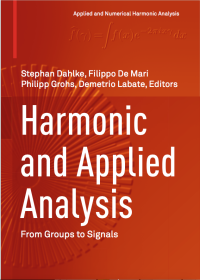
Applied and Numerical Harmonic Analysis
This book is concerned with signal analysis in its broadest sense. Usually, signals are modeled as functions in suitable spaces such as L2, the space of square integrable functions, or Sobolev spaces. Signals might be given explicitly as, for example, in image analysis or implicitly, as solutions of operator equations. In either case, the problem of interest is to analyze and process these signals, that is, to extract their information and then to manipulate the signals for tasks such as compression, denoising, and enhancement.
During the last decade, rapid advances in computing power and sensing technologies, and the exponential growth of the internet have enormously increased the availability of data, leading to what is sometimes described as the “data deluge” or “big data” problem. This situation created new opportunities and new challenges in the field of signal processing, since huge amounts of data have to be transmitted, stored, and analyzed with high efficiency. The challenges are due not only to the size of data but also to their complexity, since data acquired in many applications (think, for instance, of electronic surveillance and social media data) are often This book is concerned with signal analysis in its broadest sense. Usually, signals are modeled as functions in suitable spaces such as L2, the space of square integrable functions, or Sobolev spaces. Signals might be given explicitly as, for example, in image analysis or implicitly, as solutions of operator equations. In either case, the problem of interest is to analyze and process these signals, that is, to extract their information and then to manipulate the signals for tasks such as compression, denoising, and enhancement.
During the last decade, rapid advances in computing power and sensing tech- nologies, and the exponential growth of the internet have enormously increased the availability of data, leading to what is sometimes described as the “data deluge” or “big data” problem. This situation created new opportunities and new challenges in the field of signal processing, since huge amounts of data have to be transmitted, stored, and analyzed with high efficiency. The challenges are due not only to the size of data but also to their complexity, since data acquired in many applications (think, for instance, of electronic surveillance and social media data) are often heterogeneous and high-dimensional. Confronted and perhaps even daunted by these challenges, some scientists have already announced the “end of theory.” They claim that a rigorous mathematical theory is no longer necessary as big data “offer a higher form of intelligence and knowledge that can generate insights that were previously impossible” [1]. The whole analysis process should hence be solely data- driven because it is claimed that “correlation is more important than causation.” In other words, knowledge would be generated by combing through data with sufficient computational power in order to discover correlations by means of appropriate statistical tools. According to this point of view, the future progress of science would only depend on the increase of computing power and the clever implementation of well-established statistical algorithms.
Availability
No copy data
Detail Information
- Series Title
-
Applied and Numerical Harmonic Analysis
- Call Number
-
-
- Publisher
- USA : ., 2010
- Collation
-
1-269
- Language
-
English
- ISBN/ISSN
-
978-3-319-18863-8
- Classification
-
NONE
- Content Type
-
-
- Media Type
-
-
- Carrier Type
-
-
- Edition
-
1st Edtion
- Subject(s)
- Specific Detail Info
-
-
- Statement of Responsibility
-
-
Other version/related
No other version available
File Attachment
Comments
You must be logged in to post a comment
 Computer Science, Information & General Works
  Philosophy & Psychology
  Religion
  Social Sciences
  Language
  Pure Science
  Applied Sciences
  Art & Recreation
  Literature
  History & Geography