Information Technology
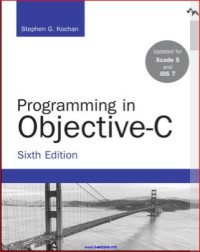
Programming in Objective-C
Dennis Ritchie at AT&T Bell Laboratories pioneered the C programming language in the early 1970s. However, this programming language did not begin to gain widespread popularity and support until the late 1970s. This was because, until that time, C compilers were not readily available for commercial use outside of Bell Laboratories. Initially, this growth in popularity was also partly spurred by the equal, if not faster, growth in popularity of the UNIX operating system, which was written almost entirely in C.
Brad J. Cox designed the Objective-C language in the early 1980s. The language was based on a language called SmallTalk-80. Objective-C was layered on top of the C language, meaning that extensions were added to C to create a new programming language that enabled objects to be created and manipulated.
NeXT Software licensed the Objective-C language in 1988 and developed its libraries and a development environment called NEXTSTEP. In 1992, Objective-C support was added to the Free Software Foundation’s GNU development environment. The copyrights for all Free Software Foundation (FSF) products are owned by the FSF. It is released under the GNU General Public License.
In 1994, NeXT Computer and Sun Microsystems released a standardized specification of the NEXTSTEP system, called OPENSTEP. The FSF’s implementation of OPENSTEP is called GNUStep. A Linux version, which also includes the Linux kernel and the GNUStep develop- ment environment, is called, appropriately enough, LinuxSTEP.
On December 20, 1996, Apple Computer announced that it was acquiring NeXT Software, and the NEXTSTEP/OPENSTEP environment became the basis for the next major release of Apple’s operating system, OS X. Apple’s version of this development environment was called Cocoa. With built-in support for the Objective-C language, coupled with development tools such as Project Builder (or its successor Xcode) and Interface Builder, Apple created a powerful develop- ment environment for application development on Mac OS X.
Availability
No copy data
Detail Information
- Series Title
-
-
- Call Number
-
-
- Publisher
- : ., 2013
- Collation
-
1-551
- Language
-
English
- ISBN/ISSN
-
978-0-321-96760-2
- Classification
-
NONE
- Content Type
-
-
- Media Type
-
-
- Carrier Type
-
-
- Edition
-
-
- Subject(s)
- Specific Detail Info
-
-
- Statement of Responsibility
-
-
Other version/related
No other version available
File Attachment
Comments
You must be logged in to post a comment
 Computer Science, Information & General Works
  Philosophy & Psychology
  Religion
  Social Sciences
  Language
  Pure Science
  Applied Sciences
  Art & Recreation
  Literature
  History & Geography