Economics
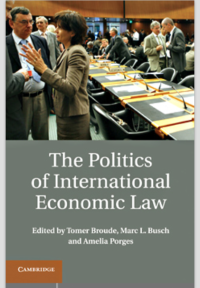
The Politics of International Economic Law
n times of crisis, we are forcefully reminded of the links between politics and international economic law.1 Indeed, the meltdown in world markets has refocused attention on how the fingerprints of the “visible hand” can be seen all over the institutions that underpin the rules of globalization. From trade and investment to finance, governments are under pressure to enforce, resist, and rewrite international economic law. To be sure, the future of the Bretton Woods institutions is, itself, the subject of heated debate. For legal scholars and political scientists, this is fertile ground; lawyers have seldom given enough attention to the influence of politics on law, whereas political scientists have had an on-again, off-again fascination with how the law influ- ences relations among states. This book is motivated by a deceptively simple question: How do politics and international economic law interact with each other
Availability
No copy data
Detail Information
- Series Title
-
The Politics of International Economic Law
- Call Number
-
-
- Publisher
- USA : Cambridge University Press., 2011
- Collation
-
1-390
- Language
-
English
- ISBN/ISSN
-
978-1-107-00355-2
- Classification
-
NONE
- Content Type
-
-
- Media Type
-
-
- Carrier Type
-
-
- Edition
-
1st Edtion
- Subject(s)
- Specific Detail Info
-
-
- Statement of Responsibility
-
-
Other version/related
No other version available
File Attachment
Comments
You must be logged in to post a comment
 Computer Science, Information & General Works
  Philosophy & Psychology
  Religion
  Social Sciences
  Language
  Pure Science
  Applied Sciences
  Art & Recreation
  Literature
  History & Geography