Information Technology
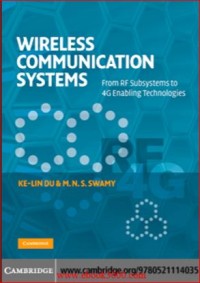
Wireless Communication Systems
Subsequent to the mathematical theory of electromagnetic waves formulated by James Clerk Maxwell in 1873 [3] and the demonstration of the existence of these waves by Heinrich Hertz in 1887, Guglielmo Marconi made history by using radio waves for transat- lantic wireless communications in 1901. In 1906, amplitude modulation (AM) radio was invented by Reginald Fessenden for music broadcasting. In 1913, Edwin H. Armstrong invented the superheterodyne receiver, based on which the first broadcast radio transmis- sion took place at Pittsburgh in 1920. Land-mobile wireless communication was first used in 1921 by the Detroit Police Department. In 1929, Vladimir Zworykin performed the first experiment of TV transmission. In 1933, Edwin H. Armstrong invented frequency mod- ulation (FM). The first public mobile telephone service was introduced in 1946 in five American cities. It was a half-duplex system that used 120kHz of FM bandwidth [4]. In 1958, the launch of the SCORE (Signal Communication by Orbital Relay Equipment) satellite ushered in a new era of satellite communications. By the mid-1960s, the FM bandwidth was cut to 30kHz. Automatic channel trunking was introduced in the 1950s and 1960s, with which full-duplex was introduced. The most important breakthrough for modern mobile communications was the concept of cellular mobile systems by AT&T Bell Laboratories in the 1970s [2]. The last two decades have seen an explosion in the growth of radio systems. Wireless communication systems migrated from the first-generation (1G) narrowband analog sys- tems in the 1980s, to the second-generation (2G) narrowband digital systems in the 1990s, to the current third-generation (3G) wideband multimedia systems that are being deployed. Meanwhile, research and development in the future-generation wideband multimedia radio systems is actively being pursued worldwide.
Availability
No copy data
Detail Information
- Series Title
-
-
- Call Number
-
-
- Publisher
- : ., 2010
- Collation
-
1-1020
- Language
-
English
- ISBN/ISSN
-
978-0-521-11403-5
- Classification
-
NONE
- Content Type
-
-
- Media Type
-
-
- Carrier Type
-
-
- Edition
-
First Edition
- Subject(s)
- Specific Detail Info
-
-
- Statement of Responsibility
-
-
Other version/related
No other version available
File Attachment
Comments
You must be logged in to post a comment
 Computer Science, Information & General Works
  Philosophy & Psychology
  Religion
  Social Sciences
  Language
  Pure Science
  Applied Sciences
  Art & Recreation
  Literature
  History & Geography