Information Technology
Building “Bring-Your-Own-Device” (BYOD) Strategies
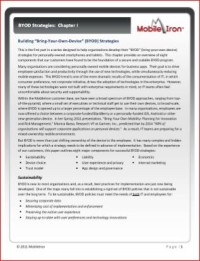
This is the first part in a series designed to help organizations develop their “BYOD” (bring-your-own-device) strategies for personally-owned smartphones and tablets. This chapter provides an overview of eight components that our customers have found to be the foundation of a secure and scalable BYOD program.
Many organizations are considering personally-owned mobile devices for business apps. Their goal is to drive employee satisfaction and productivity through the use of new technologies, while simultaneously reducing mobile expenses. This BYOD trend is one of the more dramatic results of the consumerization of IT, in which consumer preference, not corporate initiative, drives the adoption of technologies in the enterprise. However, many of these technologies were not built with enterprise requirements in mind, so IT teams often feel uncomfortable about security and supportability.
Within the MobileIron customer base, we have seen a broad spectrum of BYOD approaches, ranging from top- of-the-pyramid, where a small set of executives or technical staff get to use their own devices, to broad-scale, where BYOD is opened up to a larger percentage of the employee base. In many organizations, employees are now offered a choice between a corporate-funded BlackBerry or a personally-funded iOS, Android or other new-generation device. In her Spring 2011 presentation, “Bring Your Own Mobility: Planning for Innovation and Risk Management,” Monica Basso, Research VP at Gartner, Inc., predicted that by 2014 “90% of organizations will support corporate applications on personal devices.” As a result, IT teams are preparing for a mixed-ownership mobile environment.
Availability
No copy data
Detail Information
- Series Title
-
-
- Call Number
-
-
- Publisher
- : ., 2011
- Collation
-
1-8
- Language
-
English
- ISBN/ISSN
-
-
- Classification
-
NONE
- Content Type
-
-
- Media Type
-
-
- Carrier Type
-
-
- Edition
-
-
- Subject(s)
- Specific Detail Info
-
-
- Statement of Responsibility
-
-
Other version/related
No other version available
File Attachment
Comments
You must be logged in to post a comment
 Computer Science, Information & General Works
  Philosophy & Psychology
  Religion
  Social Sciences
  Language
  Pure Science
  Applied Sciences
  Art & Recreation
  Literature
  History & Geography