Management
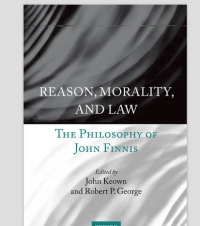
REASON, MORALITY, AND LAW
With these words, John Finnis, while still in his late 30s, began his masterwork, Natural Law and Natural Rights—the book that would not only revive scholarly interest in the venerable, but deeply misunderstood, idea of natural law and natural rights, but also powerfully challenge dominant ways of thinking among philosophers of law and moral and political philosophers in the analytic tradition.1
Future intellectual historians will no doubt present the book, together with Professor Finnis’s other philosophical writings, as part of the broad revival in more or less Aristotelian approaches to moral and political thinking that gained prominence beginning in the late 1970s. And they will be right to do so. Like Elizabeth Anscombe, David Wiggins, Philippa Foot, Alasdair MacIntyre, and many others, Finnis adopted or adapted Aristotelian methods to overcome the defects of utilitarian and other consequentialist approaches to ethics, on the one side, and Kantian or purely “deontological” approaches, on the other.
Like utilitarians, and unlike Kantians, these thinkers (who can even be called neo- Aristotelians) hold that ethical thinking must be deeply linked to considerations of human well-being or flourishing—Aristotle’s eudaimonia. But such thinking, they maintain, cannot treat the human good as subject to aggregation and calculation in a way that could somehow render coherent and workable a norm directing people to choose the option (or act on the rule) that will, for example, produce the greatest happiness of the greatest number or the net best proportion of benefit to harm overall and in the long run. So, like Kantians, they reject the belief that ethics is a matter of technical reasoning (or “cost–benefit analysis”) aimed purely and simply at producing the best possible consequences. Unlike Kantians, however, they also reject the idea of a purely deontological ethics, with its reduction of moral thinking to the domain of logic. To be sure, they accept the idea of morality as a matter of rectitude in willing, but they argue that morally wrongful choosing is not merely a matter of inconsistency in thought. Rather, immorality consists in choosing (and thus willing) in ways that are contrary to the good of human persons.
Availability
No copy data
Detail Information
- Series Title
-
REASON, MORALITY, AND LAW
- Call Number
-
-
- Publisher
- London : CPI Group (UK) Ltd,., 2013
- Collation
-
1-628
- Language
-
English
- ISBN/ISSN
-
978–0–19–967550–0
- Classification
-
NONE
- Content Type
-
-
- Media Type
-
-
- Carrier Type
-
-
- Edition
-
1st Edtion
- Subject(s)
- Specific Detail Info
-
-
- Statement of Responsibility
-
-
Other version/related
No other version available
File Attachment
Comments
You must be logged in to post a comment
 Computer Science, Information & General Works
  Philosophy & Psychology
  Religion
  Social Sciences
  Language
  Pure Science
  Applied Sciences
  Art & Recreation
  Literature
  History & Geography