Information Technology
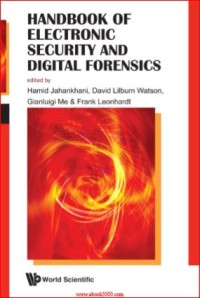
HANDBOOK OF ELECTRONIC SECURITY AND DIGITAL FORENSICS
Often, in past years, the computer systems were isolated from other systems; each system had its specific job and worked alone to execute it. Today, computer systems have grown exponentially both in number and in size. They, generally, are interconnected and collaborated to each other exchanging information and sharing resources. The problem with this pervasive presence of computer systems and networks is that malicious attacks can cause loss of data, can deny regular services provided by these systems, can cause disclosure of secret information and moreover can cause loss of money. In this chapter, we will talk about two main topics: operating systems (OS) security and networks security. Both are needed in order to achieve a robust system able to resist different types of attacks. A good starting point to achieve security is a secure OS. The OS manages directly the devices (CPU, memory, display, etc.); it is a layer between the user programs and the underlying hardware. A secure OS can protect the system using mechanisms like the reference monitor, host intrusion detection systems, access control, among others. In Sections 1.2 and 1.3, we will talk about this aspect, focusing also in the criteria to evaluate the OS security. In Section 1.4, the concept of hard existing OSs is introduced, since an harden system can assure more security and more reliability than a standard configurations.
Availability
No copy data
Detail Information
- Series Title
-
-
- Call Number
-
-
- Publisher
- : ., 2010
- Collation
-
1-708
- Language
-
English
- ISBN/ISSN
-
978-981-283-703-5
- Classification
-
NONE
- Content Type
-
-
- Media Type
-
-
- Carrier Type
-
-
- Edition
-
-
- Subject(s)
- Specific Detail Info
-
-
- Statement of Responsibility
-
-
Other version/related
No other version available
File Attachment
Comments
You must be logged in to post a comment
 Computer Science, Information & General Works
  Philosophy & Psychology
  Religion
  Social Sciences
  Language
  Pure Science
  Applied Sciences
  Art & Recreation
  Literature
  History & Geography