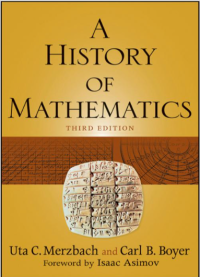
Mathematics
A History of Mathematics
During the two decades since the appearance of the second edition of this work, there have been substantial changes in the course of mathe- matics and the treatment of its history. Within mathematics, outstanding results were achieved by a merging of techniques and concepts from previously distinct areas of specialization. The history of mathematics continued to grow quantitatively, as noted in the preface to the second edition; but here, too, there were substantial studies that overcame the polemics of “internal” versus “external” history and combined a fresh approach to the mathematics of the original texts with the appropriate linguistic, sociological, and economic tools of the historian.
In this third edition I have striven again to adhere to Boyer’s approach to the history of mathematics. Although the revision this time includes the entire work, changes have more to do with emphasis than original content, the obvious exception being the inclusion of new findings since the appearance of the first edition. For example, the reader will find greater stress placed on the fact that we deal with such a small number of sources from antiquity; this is one of the reasons for condensing three previous chapters dealing with the Hellenic period into one. On the other hand, the chapter dealing with China and India has been split, as content demands. There is greater emphasis on the recurring interplay between pure and applied mathematics as exemplified in chapter 14. Some reorganization is due to an attempt to underline the impact of institu- tional and personal transmission of ideas; this has affected most of the pre-nineteenth-century chapters. The chapters dealing with the nineteenth century have been altered the least, as I had made substantial changes for some of this material in the second edition. The twentieth-century material has been doubled, and a new final chapter deals with recent trends, including solutions of some longstanding problems and the effect of computers on the nature of proofs.
It is always pleasant to acknowledge those known to us for having had an impact on our work. I am most grateful to Shirley Surrette Duffy for responding judiciously to numerous requests for stylistic advice, even at times when there were more immediate priorities. Peggy Aldrich Kid- well replied with unfailing precision to my inquiry concerning certain photographs in the National Museum of American History. Jeanne LaDuke cheerfully and promptly answered my appeals for help, espe- cially in confirming sources. Judy and Paul Green may not realize that a casual conversation last year led me to rethink some recent material. I have derived special pleasure and knowledge from several recent pub- lications, among them Klopfer 2009 and, in a more leisurely fashion, Szpiro 2007. Great thanks are due to the editors and production team of John Wiley & Sons who worked with me to make this edition possible: Stephen Power, the senior editor, was unfailingly generous and diplo- matic in his counsel; the editorial assistant, Ellen Wright, facilitated my progress through the major steps of manuscript creation; the senior production manager, Marcia Samuels, provided me with clear and concise instructions, warnings, and examples; senior production editors Kimberly Monroe-Hill and John Simko and the copyeditor, Patricia Waldygo, subjected the manuscript to painstakingly meticulous scrutiny. The professionalism of all concerned provides a special kind of encouragement in troubled times.
I should like to pay tribute to two scholars whose influence on others should not be forgotten. The Renaissance historian Marjorie N. Boyer (Mrs. Carl B. Boyer) graciously and knowledgeably complimented a young researcher at the beginning of her career on a talk presented at a Leibniz conference in 1966. The brief conversation with a total stranger did much to influence me in pondering the choice between mathematics and its history.
More recently, the late historian of mathematics Wilbur Knorr set a significant example to a generation of young scholars by refusing to accept the notion that ancient authors had been studied definitively by others. Setting aside the “magister dixit,” he showed us the wealth of knowledge that emerges from seeking out the texts.
Availability
No copy data
Detail Information
- Series Title
-
-
- Call Number
-
-
- Publisher
- : ., 2011
- Collation
-
-
- Language
-
English
- ISBN/ISSN
-
978 0 470 630563
- Classification
-
NONE
- Content Type
-
-
- Media Type
-
-
- Carrier Type
-
-
- Edition
-
THIRD EDITION
- Subject(s)
-
-
- Specific Detail Info
-
-
- Statement of Responsibility
-
-
Other version/related
No other version available
File Attachment
Comments
You must be logged in to post a comment
 Computer Science, Information & General Works
  Philosophy & Psychology
  Religion
  Social Sciences
  Language
  Pure Science
  Applied Sciences
  Art & Recreation
  Literature
  History & Geography