Mathematics
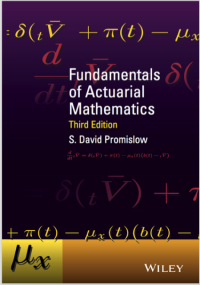
Fundamentals of Actuarial Mathematics
The third edition of this book continues the objective of providing coverage of actuarial mathematics in a flexible manner that meets the needs of several audiences. These range from those who want only a basic knowledge of the subject, to those preparing for careers as professional actuaries. All this is carried out with a streamlined system of notation, and a modern approach to computation involving spreadsheets.
The text is divided into four parts. The first two cover the subject of life contingencies. The modern approach towards this subject is through a stochastic model, as opposed to the older deterministic viewpoint. I certainly agree that mastering the stochastic model is the desirable goal. However, my classroom experience has convinced me that this is not the right place to begin the instruction. I find that students are much better able to learn the new ideas, the new notation, the new ways of thinking involved in this subject, when done first in the simplest possible setting, namely a deterministic discrete model. After the main ideas are presented in this fashion, continuous models are introduced. In Part II of the book, the full stochastic model of life contingencies can be dealt with in a reasonably quick fashion.
Another innovation in Part II is to depart from the conventional treatment of life contin- gencies as dealing essentially with patterns of mortality or disability in a group of human lives. Throughout Part II, we deal with general failure times which makes the theory more widely adaptable.
Part III deals with more advanced stochastic models. Following an introduction to stochas- tic processes, there is a chapter covering multi-state theory, an approach which unifies many of the ideas in Parts I and II. The final chapter in Part III is an introduction to modern financial mathematics.
Part IV deals with the subject of risk theory, sometime referred to as loss models. It includes an extensive coverage of classical ruin theory, a topic that originated in actuarial science but recently has found many applications in financial economics. It also includes credibility theory, which will appeal to the reader interested more in the casualty side of actuarial mathematics.
This book will meet the needs of those preparing for the examinations of many of the major professional actuarial organizations. Parts I to III of this new third edition covers all of the material on the current syllabuses of Exam MLC of the Society of Actuaries and Canadian Institute of Actuaries and Exam LC of the Casualty Actuarial Society, and covers most of the topics on the current syllabus of Exam CT5 of the British Institute of Actuaries.
Availability
No copy data
Detail Information
- Series Title
-
-
- Call Number
-
-
- Publisher
- : ., 2015
- Collation
-
-
- Language
-
English
- ISBN/ISSN
-
978-1-118-78246-0
- Classification
-
NONE
- Content Type
-
-
- Media Type
-
-
- Carrier Type
-
-
- Edition
-
Third Edition
- Subject(s)
-
-
- Specific Detail Info
-
-
- Statement of Responsibility
-
-
Other version/related
No other version available
File Attachment
Comments
You must be logged in to post a comment
 Computer Science, Information & General Works
  Philosophy & Psychology
  Religion
  Social Sciences
  Language
  Pure Science
  Applied Sciences
  Art & Recreation
  Literature
  History & Geography