Management
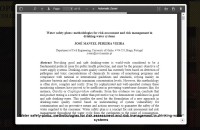
Water safety plans: methodologies for risk assessment and risk management in drinking-water systems
Providing good and safe drinking-water is world-wide considered to be a
fundamental political issue for public health protection, and must be the primary objective of
water supply systems. Drinking-water quality control has currently been based on detection of
pathogens and toxic concentrations of chemicals by means of monitoring programs and
compliance with national or international guidelines and standards, relying mainly on
indicator bacteria and chemicals maximum concentration levels. However, this methodology
is often slow, complex and costly. Even for sophisticated and well-operated systems these
monitoring schemes have proved to be inefficient in preventing waterborne diseases like, for
instance, Giardia or Cryptosporidium outbreaks. From this evidence we can conclude that
end-product testing is a reactive rather than preventive way to demonstrate confidence in good
and safe drinking-water. This justifies the need for the formulation of a new approach in
drinking-water quality control based on understanding of system vulnerability for
contamination and on preventive means and actions necessary to guarantee the safety of the
water supplied to the consumer. Water safety plan is a concept for risk assessment and risk
management throughout the water cycle from the catchments to the point of consumption.
This approach includes the identification of the hazards and introduction of control points that
serve to minimize these potential hazards, providing for more effective control of drinkingwater
quality. This paper presents an overview of the first two years experience in developing
and implementing a water safety plan in a Portuguese multi-municipal water company. Since
key personnel had contributed to the assessment of hazards and evaluation of corrective
actions for control points, a greater understanding of water quality control and improvements
on technical operation and performance have been registered, demonstrating good value for
the methodology.
Availability
No copy data
Detail Information
- Series Title
-
-
- Call Number
-
-
- Publisher
- : .,
- Collation
-
1-13
- Language
-
English
- ISBN/ISSN
-
-
- Classification
-
NONE
- Content Type
-
-
- Media Type
-
-
- Carrier Type
-
-
- Edition
-
-
- Subject(s)
-
-
- Specific Detail Info
-
-
- Statement of Responsibility
-
-
Other version/related
No other version available
File Attachment
Comments
You must be logged in to post a comment
 Computer Science, Information & General Works
  Philosophy & Psychology
  Religion
  Social Sciences
  Language
  Pure Science
  Applied Sciences
  Art & Recreation
  Literature
  History & Geography