Healthcare Management
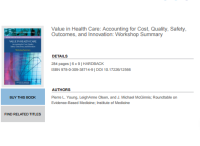
Value in Health Care
The United States has the highest per capita spending on health care of any industrialized nation—50 percent greater than the second highest and twice as high as the average for Europe (Peterson and Burton, 2009). Current U.S. healthcare costs are projected at nearly $2.5 trillion, about 17 percent of the entire economy (Sisko et al., 2009). The Congressional Budget Office estimated that Medicare and Medicaid alone will account for nearly a quarter of the economy by 2050 if healthcare costs grow at just 2 percent more than GDP per capita each year (Congressional Budget Office, 2007). At these levels of spending, healthcare expenditures have begun to restrict the ability of federal and state governments to fund other priorities such as education (White House, 2009). Yet despite the unprecedented levels of spending, harmful medical errors abound (IOM, 2000), uncoordinated care continues to frustrate patients and providers, and U.S. healthcare costs continue to increase (Sisko et al., 2009). With the growing ranks of the uninsured, the nation faces significant social costs, with lost productivity and increasing disparities in health outcomes (IOM, 2003). An aging population with a higher prevalence of chronic dis- eases and many patients with multiple conditions together constitute another complicating factor in the trend to higher costs of care (Martini et al., 2007; Meara et al., 2004; Strunk and Ginsburg, 2002).
Availability
No copy data
Detail Information
- Series Title
-
-
- Call Number
-
-
- Publisher
- : ., 2009
- Collation
-
1-287
- Language
-
English
- ISBN/ISSN
-
978-0-309-38714-9
- Classification
-
NONE
- Content Type
-
-
- Media Type
-
-
- Carrier Type
-
-
- Edition
-
-
- Subject(s)
- Specific Detail Info
-
-
- Statement of Responsibility
-
-
Other version/related
No other version available
File Attachment
Comments
You must be logged in to post a comment
 Computer Science, Information & General Works
  Philosophy & Psychology
  Religion
  Social Sciences
  Language
  Pure Science
  Applied Sciences
  Art & Recreation
  Literature
  History & Geography