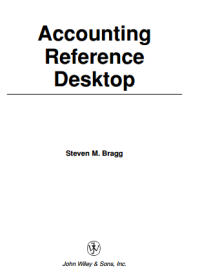
Accounting
Accounting Reference
The intention of this book is to give the accountant the answers to the largest possible number of accounting issues that are likely to arise. Thus, given the wide-ranging scope of this work, the reader should know about its overall structure in order to locate infor- mation more easily.
The Accounting Reference Desktop is divided into eight parts, each of which deals with a different aspect of the accounting function. The first part covers the role of account- ing within the modern corporation. Chapter 2, The Role of Accounting, describes the pri- mary tasks for which the accountant is responsible, as well as ethical concerns, and lists the job descriptions of the major positions to be found within the accounting department. Chapter 3, The Corporate Structure, describes the organizational layout of the typical cor- poration, how the transactional systems maintained by the accounting department interact with these other functions, and how the organizational structure can alter the types of accounting systems used.
The second part deals with accounting rules and regulations. Chapter 4, Standard Setting Organizations, describes the origins and responsibilities of the various rule-setting bodies that have created Generally Accepted Accounting Principles (GAAP), not only for United States business entities, but also for government and international organizations. Chapter 5, Accounting Standards, lists all of the various accounting pronouncements, such as FASB Interpretations, FASB Statements, and FASB Technical Bulletins, in summary form; the reader can peruse this list of original source documents in order to determine what additional research may be needed to delve into a particular GAAP issue. Chapter 6, The Securities and Exchange Commission, gives an overview of the Securities and Exchange Commission (SEC), the EDGAR on-line reporting system, and the Acts and SEC regulations that govern the reporting requirements of publicly held corporations.
The third part covers the general format and rules governing the information con- tained within accounting reports. Chapter 7, The Balance Sheet and Statement of Stockholders’ Equity, describes the format of the balance sheet and statement of retained earnings, as well as the definitions of the various categories of assets, liabilities, and equity items that are listed in these reports. Chapter 8, The Income Statement, describes the format of the income statement, as well as the rules governing the presentation of information about discontinued operations, earnings per share, gains and losses, account- ing changes, discontinued operations, extraordinary items, other comprehensive income, and prior period adjustments. Chapter 9, The Statement of Cash Flows, describes the for- mat of the statement of cash flows, as well as exemptions from its use and how to handle foreign currency translations when constructing it
Availability
No copy data
Detail Information
- Series Title
-
Accounting Reference
- Call Number
-
-
- Publisher
- Canada : ohn Wiley and Sons, Inc.., 2002
- Collation
-
1-622
- Language
-
English
- ISBN/ISSN
-
-
- Classification
-
NONE
- Content Type
-
-
- Media Type
-
-
- Carrier Type
-
-
- Edition
-
1st Edtion
- Subject(s)
- Specific Detail Info
-
-
- Statement of Responsibility
-
-
Other version/related
No other version available
File Attachment
Comments
You must be logged in to post a comment
 Computer Science, Information & General Works
  Philosophy & Psychology
  Religion
  Social Sciences
  Language
  Pure Science
  Applied Sciences
  Art & Recreation
  Literature
  History & Geography