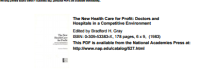
Management
The New Health Care for Profit
Our entire health care system is organized largely to carry out decisions made by highly autonomous and independent physicians. Hospitals, for example, are organized to respond to physicians' decisions—even implementing them when the physicians are not physically present. Many aspects of our health care system rest on an assumption that the physician's primary concern is with the needs and care of the patient. Assumptions about motivations—e.g., about whether the physician or hospital primarily seeks to provide needed services or to maximize revenues—must affect the degree of trust between doctor and patient and between society and the medical profession (including the organizations within which physicians practice). In part because the science and technology of medicine are complex and often changing, nonphysicians have tended to leave to the medical profession such matters as criteria or standards for licensure, certification, curriculum development, quality assurance, and academic or institutional accreditation. All of these arrangements reflect high public trust in the medical profession. The strength of this trust arguably will affect all other matters in health care—the behavior of medical institutions; the distribution, utilization, and cost of services; future regulatory strategies in health care; and even patient outcomes
Availability
No copy data
Detail Information
- Series Title
-
-
- Call Number
-
-
- Publisher
- : ., 1983
- Collation
-
1-187
- Language
-
English
- ISBN/ISSN
-
0-309-53383-X
- Classification
-
NONE
- Content Type
-
-
- Media Type
-
-
- Carrier Type
-
-
- Edition
-
-
- Subject(s)
- Specific Detail Info
-
-
- Statement of Responsibility
-
-
Other version/related
No other version available
File Attachment
Comments
You must be logged in to post a comment
 Computer Science, Information & General Works
  Philosophy & Psychology
  Religion
  Social Sciences
  Language
  Pure Science
  Applied Sciences
  Art & Recreation
  Literature
  History & Geography