Information Technology
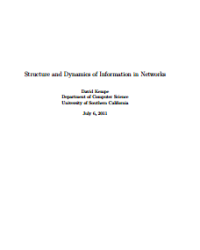
Structure and Dynamics of Information in Networks
This course is about the interplay between link network structure and information. There are two natural ways in which these can interact: The information can spread by using the edges of the network, or the network itself can be (part of) the information to be analyzed. Naturally, these two views are not mutually exclusive: often, we will want to analyze networks whose function it is to spread information. Similarly, the mere existence of a network to go with other information will often allow for information to spread as well. Lest this discussion be too abstract, let us begin by considering two of the most prominent types of networks in this course:
1. The World Wide Web (WWW) consists of web pages and the links between them. The links add sig- nificantly to the (textual and other) information content of the pages. They allow a focused navigation of the body of text. Furthermore, they indicate which pages may be about related topics, or more relevant, by virtue of heavy linking patterns. Thus, the WWW predominantly falls into the second category above. However, since the owners of web pages will also have access to the pages they link to, or pages further down chains of links, information tends to propagate along links as well, as pages copy important information from others.
2. Social Networks are made up of individuals and their relationships, such as friendships, collaborations, romantic relationships, etc. They serve many different functions, including social support, economic exchanges, and — quite crucially — the spread of information. Thus, they fall more into the first category. However, the mere fact that an individual forms links with others tends to imply that they might care about similar information, or share similar interests. Thus, the network structure also reveals a great deal of information about the individuals, beyond what could be discerned with standard socio-economic questions.
The great proliferation of networked bodies of information, and the much more ready availability of data on all kinds of networks, have recently led to a significant increase in interest in computational analysis of such networks. In many scenarios, such analysis, beyond its scientific interest, also has significant commercial or other benefit. For an example, look no further than the importance of web search, which we will discuss in more detail in Chapter 2.
Before embarking on our exploration of many of the algorithmic questions in this broad domain, we should revisit one of the visionary thinkers, who anticipated many of the recent developments and challenges well before computers were used pervasively, or most of the technologies were availabl
Availability
No copy data
Detail Information
- Series Title
-
Structure and Dynamics of Information in Networks
- Call Number
-
-
- Publisher
- California : ., 2011
- Collation
-
1-118
- Language
-
English
- ISBN/ISSN
-
-
- Classification
-
NONE
- Content Type
-
-
- Media Type
-
-
- Carrier Type
-
-
- Edition
-
1st Edtion
- Subject(s)
- Specific Detail Info
-
-
- Statement of Responsibility
-
-
Other version/related
No other version available
File Attachment
Comments
You must be logged in to post a comment
 Computer Science, Information & General Works
  Philosophy & Psychology
  Religion
  Social Sciences
  Language
  Pure Science
  Applied Sciences
  Art & Recreation
  Literature
  History & Geography