Social Science
Civil Rights and Civil Liberties
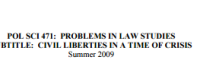
This course is designed to familiarize you, the dutiful student, with Supreme Court policy making in the form of the Court’s written opinions. The Supreme Court, the highest judicial institution in the United States, makes decisions that affect the lives of people all over the country. In this course, I hope to promote an understanding and appreciation of the profound influence the Supreme Court has on life as we know and love it today, as well as to convey the very political nature of this institution. All too often, we Americans subscribe to the myth which surrounds this highest of legal institutions, shrouding it in the “cult of the robe,” placing its justices above politics and above the “humanness” of humanity. However true that may be in theory, since the creation of the High Court was indeed a means to check popular control of government, it is not true in reality. Politics plays an everyday role in the functioning of the Supreme Court, evidenced by the occasional ruckus surrounding a Supreme Court nomination, or picketing outside the Court over an unpopular opinion, or political mobilization over a Constitutional amendment to overrule a Court decision. Politics is present on the Court, both in the outside forces that hope to influence it, and in the internally-held policy preferences of its justices. Even the Constitution is not without controversy, as it is an extremely vaguely written document, able to be convincingly construed in any number of ways. Hence the many conflicting opinions written by the justices themselves, charged to make sense of our forefathers’ legacy.
Availability
No copy data
Detail Information
- Series Title
-
-
- Call Number
-
-
- Publisher
- : ., 2013
- Collation
-
1-12
- Language
-
English
- ISBN/ISSN
-
-
- Classification
-
NONE
- Content Type
-
-
- Media Type
-
-
- Carrier Type
-
-
- Edition
-
-
- Subject(s)
- Specific Detail Info
-
-
- Statement of Responsibility
-
-
Other version/related
No other version available
File Attachment
Comments
You must be logged in to post a comment
 Computer Science, Information & General Works
  Philosophy & Psychology
  Religion
  Social Sciences
  Language
  Pure Science
  Applied Sciences
  Art & Recreation
  Literature
  History & Geography