Social Science
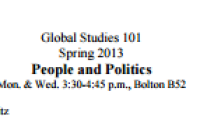
People and Politics
We begin with basic questions and theories. Why do states adopt certain goals or objectives, and pursue particular foreign military and economic policies? Why do wars start and end? Why are they fought in certain ways? What role is played by objective factors, such as the balance of power, uncertainty, and the ability to make “credible commitments”? How does the political system or “regime type” affect choices of objectives (“leadership preferences”)? How do leadership preferences and regime type affect the likelihood and strategy of war? We will apply the theories to a series of case studies of major international conflicts—World War I, World War II, and the Cold War. Backing up a step, the existence of particular states in particular territorial forms should not be taken for granted. Where do states come from? What is a people or nation? How does a nation form and become the nucleus of a state? To the extent that nations are constitutive of states, what are the typical forms of conflicts among nation-states, or between existing nation-states and internal ethnic minorities aspiring to statehood? Why do such conflicts turn violent? Why are they fought in the way they are? Why do they end or persist? What determines whether and how other states intervene in ethnic conflicts— whether independently or through international organizations?
Availability
No copy data
Detail Information
- Series Title
-
-
- Call Number
-
-
- Publisher
- : ., 2013
- Collation
-
1-7
- Language
-
English
- ISBN/ISSN
-
-
- Classification
-
NONE
- Content Type
-
-
- Media Type
-
-
- Carrier Type
-
-
- Edition
-
-
- Subject(s)
- Specific Detail Info
-
-
- Statement of Responsibility
-
-
Other version/related
No other version available
File Attachment
Comments
You must be logged in to post a comment
 Computer Science, Information & General Works
  Philosophy & Psychology
  Religion
  Social Sciences
  Language
  Pure Science
  Applied Sciences
  Art & Recreation
  Literature
  History & Geography