Filter by
Document Process Management
Business documents are vital strategic, financial, operational and intellectual assets that are essential to daily business processes. They constitute the lifeblood of an organization. Yet half of organizations rate their document management practices as less than effective. This is why document process management is becoming an outsourcing strategy that enables organizations to reduce cost…
- Edition
- -
- ISBN/ISSN
- -
- Collation
- 1-7
- Series Title
- -
- Call Number
- -

The Executive Buyer’s Guide to Project Portfolio Management
IT organizations face an infinite number of existing and new projects to manage with finite resources. Against a backdrop of shrinking budgets, IT must ensure that every project receiving IT resources is of strategic value to the company and is being responsibly managed to successful completion. To better manage their portfolio of project investments, IT organizations are turning to Project Por…
- Edition
- -
- ISBN/ISSN
- -
- Collation
- 1-16
- Series Title
- -
- Call Number
- -
THE BUSINESS CASE FOR PROJECT PORTFOLIO MANAGEMENT
The expression “better, faster, cheaper” is commonly associated with supply chain initiatives, where companies have developed an edge by getting products to market faster and more efficiently than their competitors. However, in the new world of cloud computing, more companies are looking at their IT department as a competitive differentiator by enabling them to quickly deploy hosted appli…
- Edition
- -
- ISBN/ISSN
- -
- Collation
- 1-6
- Series Title
- -
- Call Number
- -
Improve Quality, Save Time and Money
What if you could save money while developing high- quality training, technical documentation and even online help, all at the same time? You can! It’s called single sourcing and it’s all about eliminating duplication of work and ensuring consistency across your entire product suite. Simply by writing all the documentation for your product in one file, you can deliver a user manual and a…
- Edition
- -
- ISBN/ISSN
- -
- Collation
- 1-5
- Series Title
- -
- Call Number
- -
Should You Invest in GRC Tools?
As regulations grow in number and complexity, budgets get constrained, and the need for holistic view of risks increases, organizations are adopting GRC strategies to stay on top of their risk and compliance needs. But a GRC strategy is only as good as the tools used to implement it. If your approach is reactive, adhoc, and compartmentalized in different departments, you need to move to an auto…
- Edition
- -
- ISBN/ISSN
- -
- Collation
- 1-6
- Series Title
- -
- Call Number
- -
IT GRC: Turning Operational Risks into Returns
Recent financial upheavals have resulted in a wave of increased regulations, and organizations are facing increasingly stringent government scrutiny and audit requirements. As a result, companies across the spectrum must implement an effective IT governance, risk and compliance (GRC) framework. Organizations, from small and mid-sized companies to global enterprises, are affected by changing and…
- Edition
- -
- ISBN/ISSN
- -
- Collation
- 1-8
- Series Title
- -
- Call Number
- -
ITIL for the Small and Midsized Business
Small and midsized businesses experience business issues and challenges that are inherently different from those of larger enterprises. They generally have smaller workforces, lower budgets, and less complex IT environments than enterprise organizations. And yet, small and midsized businesses must meet the same types of demands as enterprise organizations, and optimize service levels to sup…
- Edition
- -
- ISBN/ISSN
- 61096
- Collation
- 1-8
- Series Title
- -
- Call Number
- -
Combine ITIL and COBIT to Meet Business Challenges
IT organizations are under increasing pressure to meet the business goals of their companies. This challenge can be particularly daunting because it involves complying with regulations, such as the Sarbanes- Oxley Act (Sarbox) and Basel II. Compliance requires strong corporate governance capabilities that are demonstrable to outside auditors. Because IT plays such a major role in business proce…
- Edition
- -
- ISBN/ISSN
- 61709.
- Collation
- 1-16
- Series Title
- -
- Call Number
- -
Four steps to Developing a Service Management Strategy for Midsized Business
In today’s competitive business environment, small and midsized businesses that want to grow and sustain an edge in the market must continually streamline and improve core business practices. In many instances, technology-based solutions are integral to achieving operational efficiencies and to furthering key business objectives. As businesses progress from small to midsize organizations,…
- Edition
- -
- ISBN/ISSN
- -
- Collation
- 1-14
- Series Title
- -
- Call Number
- -

Stretching the Software Budget: A Practical Guide to Enterprise License Optim…
Software is of tremendous importance to today’s IT-intensive organizations. In fact, the appetite of organizations for software is growing at a faster pace than software budgets—especially in light of current economic conditions. It is therefore more critical than ever for software buyers to get maximum value out of every dollar they spend on software.
- Edition
- -
- ISBN/ISSN
- -
- Collation
- 1-9
- Series Title
- -
- Call Number
- -
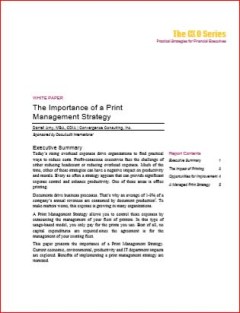
The Importance of a Print Management Strategy
Today’s rising overhead expenses drive organizations to find practical ways to reduce costs. Profit-conscious executives face the challenge of either reducing headcount or reducing overhead expenses. Much of the time, either of these strategies can have a negative impact on productivity and morale. Every so often a strategy appears that can provide significant expense control and enhance prod…
- Edition
- -
- ISBN/ISSN
- -
- Collation
- 1-7
- Series Title
- -
- Call Number
- -
The State of Resilience and Optimization on IBM Power Systems
The AS/400 and RS/6000 platforms have evolved greatly over 20 years, and now IBM has brought them together to create the Power Systems server line. The technologies and methods for data protection and system optimization for both platforms have seen great changes as well. Even as transaction and data storage volumes have increased, ensuring that the right data protection and management practice…
- Edition
- -
- ISBN/ISSN
- -
- Collation
- 1-23
- Series Title
- -
- Call Number
- -
Complying with Financial Services Regulations Through Information Availability
Over the past five years, some of the most wide-ranging and demanding financial management and disclosure regulations in U.S. history have come into force such as the Gramm-Leach-Bliley and Sarbanes-Oxley Acts. Not complying with these regulations may have serious consequences for you and your financial services institution. The goals of this white paper are to explain the impact of specific r…
- Edition
- -
- ISBN/ISSN
- -
- Collation
- 1-18
- Series Title
- -
- Call Number
- -
System i Optimization Best Practices
System i is at the heart of the IT infrastructure for many organizations. Companies around the globe depend on the platform to provide reliable performance for their sales, operations, human resources, accounting, shipping and other critical applications. While it is true that System i is one of the easiest to manage business systems in the world, it is still far from entirely self-managing or …
- Edition
- -
- ISBN/ISSN
- -
- Collation
- 1-12
- Series Title
- -
- Call Number
- -
The Essential Guide to Disaster Recovery
For today’s small and mid-sized businesses, the risk and effects from any unplanned outage (downtime) grow with each additional critical application, network enhancement or system upgrade. We don’t have to look back very far to see the consequences of sudden or unexpected disasters affecting the IT infrastructure of major cities and businesses of every description. Consequently, IT man…
- Edition
- -
- ISBN/ISSN
- -
- Collation
- 1-15
- Series Title
- -
- Call Number
- -

Top Ten Reasons to Go Green in IT
IT equipment accounts for nine percent of all energy consumed by businesses—the third-largest source of power for the commercial sector. With the right power management policies in place, you’ll have better control over your entire network–not only over how much power is consumed, but also how–and when- computers are powered down. This new control allows you to more successfully exe…
- Edition
- -
- ISBN/ISSN
- -
- Collation
- 1-6
- Series Title
- -
- Call Number
- -
TAKING THE "ENTITLEMENT" OUT OF ENTERPRISE SOFTWARE
Enterprise software changed the face of business over the last decade. However, afters of aggressive enterprise software buying, corporations are now saddled with a large portfolio of solutions that are expensive to upgrade and have become equally expensive to maintain and support.
- Edition
- -
- ISBN/ISSN
- -
- Collation
- 1-12
- Series Title
- -
- Call Number
- -
Security and control
The continuing evolution of malware threats combined with the demand for increasingly flexible working practices is a significant challenge to IT departments seeking to reduce help desk support and get better value for money from their investment in security. This paper looks at how organizations can benefit from a more integrated, policy-driven approach to protecting the network at all leve…
- Edition
- -
- ISBN/ISSN
- -
- Collation
- 1-7
- Series Title
- -
- Call Number
- -
Solving the Password Management Paradox
Organizations need to protect their data and restrict access to enterprise resources to authorized users. Many companies attempt to address their security concerns by simply implementing stronger password policies, requiring employees to remember more and stronger passwords for all applications. However, most employees can not remember more than one or two strong passwords, so they won’t f…
- Edition
- -
- ISBN/ISSN
- -
- Collation
- 1-19
- Series Title
- -
- Call Number
- -
How to Access and Buy Business Management Software
For most companies, changing accounting software is a daunting challenge. Not only is transitioning the accounting function to a new software package tricky in itself, but it is usually catalyzed by one or more business challenges that are (hopefully) solved by the new system. As a result, most companies wait until problems have become (or are obviously becoming) insurmountable before initiatin…
- Edition
- -
- ISBN/ISSN
- -
- Collation
- 1-9
- Series Title
- -
- Call Number
- -

Sarbanes-Oxley Simplified
The Sarbanes-Oxley Act of 2002 (“SOX”) puts a new emphasis on timeliness and transparency in financial reporting, and the importance of internal controls in managing a public company. As of November 2004, SOX became a requirement for larger companies traded on a U.S. stock exchange; smaller public companies have until July 2007 to comply. This whitepaper provides an overview of, and s…
- Edition
- -
- ISBN/ISSN
- -
- Collation
- 1-8
- Series Title
- -
- Call Number
- -
SPAZIO FILE AUDIT & CONTROL DEFINITION & BENEFITS
Over the years a variety of file transfer tools and techniques have been utilized to support the file transfer needs of internal systems as well as file transfers with external partners. The file transfer process has become complex, involving differing platforms, technologies, processing methods and support. Each process has been developed separately to meet differing requirements resulting in …
- Edition
- -
- ISBN/ISSN
- -
- Collation
- 1-13
- Series Title
- -
- Call Number
- -
Optimizing IT Performance
Over the last few years, corporations have been under incre- ased pressure to optimize resource utilization while at the same time adapting more quickly to changes required by the business. This pressure has direct impact on IT organizati- ons faced with more complex installations that need to be implemented, enhanced and managed with fewer allocated resources. Most organizations have invested…
- Edition
- -
- ISBN/ISSN
- -
- Collation
- 1-8
- Series Title
- -
- Call Number
- -
Actual Storage Utilization and your IT Bottom Line
IT budgets are shrinking even as the reliance on data availability grows. Now more than ever, IT managers must spend carefully to keep from negatively impacting the bottom line. One area where IT departments can realize significant savings is in storage. This document provides a simple breakdown of the actual costs paid for storage when real-world utilization and performance numbers, in additi…
- Edition
- -
- ISBN/ISSN
- -
- Collation
- 1-7
- Series Title
- -
- Call Number
- -
HOW TO GET ITIL DONE
Few would argue over the crucial role of IT in today’s economy. In our lifetime, we have witnessed IT evolve from a limited service function into a critical core competency of modern organizations. Stepping out of the shadows and into the limelight has created new challenges for IT, however. Expectations have risen dramatically throughout all levels of the organization and its ecosystem of…
- Edition
- -
- ISBN/ISSN
- -
- Collation
- 1-5
- Series Title
- -
- Call Number
- -
Selection Criteria for Remote Support Tools “Best of Breed” Products Spee…
Remote support technology is one of the most popular service and support automation tools for high-tech companies, with a well understood and easily documented return on investment story. Though basic remote control is available from many sources, including some freeware and shareware options, companies interested in improving both the economics of support and the customer experience should und…
- Edition
- -
- ISBN/ISSN
- -
- Collation
- 1-15
- Series Title
- -
- Call Number
- -
Improving Customer Support and Help Desk Efficiencies with On-Demand Remote S…
When today's businesses run 24/7 on fewer IT-dollars, the relentless job of supporting employees, suppliers, business partner, and customers is an organizational necessity and one of the biggest challenges facing support organizations.
- Edition
- -
- ISBN/ISSN
- -
- Collation
- 1-13
- Series Title
- -
- Call Number
- -

Achieving sustainable business growth with a remote support solution
Are you expanding your reach into international markets without knowing how you will provide cost-effective, quality support? If you are, you’re not alone. According to the Small Business Administration, the number of American businesses sending their goods and services overseas has tripled since 1990. About two-thirds of that boom comes from companies with fewer than 20 employees. No longe…
- Edition
- -
- ISBN/ISSN
- -
- Collation
- 1-17
- Series Title
- -
- Call Number
- -
5 Steps to Protect Your Automation Applications from Downtime
If you are involved with managing process automation, building automation, or security systems, you know the complexity of your IT systems can often create failures and indecision that result in downtime. And downtime can blow your production schedule, put lives at risk, and your company in financial peril. Redundancy is a time-tested method to ensure availability of PLCs, monitoring, control…
- Edition
- -
- ISBN/ISSN
- -
- Collation
- 1-10
- Series Title
- -
- Call Number
- -

Legacy Tools: Not Built for Today’s Helpdesk
Today’s modern enterprise seeks both efficiency and productivity — constantly looking for new and effective ways to boost employee workflow. This new enterprise includes branch employees, teleworkers, and on-the-go workforces that communicate using a variety of mobile devices. But hidden somewhere in many corporate helpdesk closets are tools being used for support that may impede the effect…
- Edition
- -
- ISBN/ISSN
- -
- Collation
- 1-8
- Series Title
- -
- Call Number
- -
 Computer Science, Information & General Works
  Philosophy & Psychology
  Religion
  Social Sciences
  Language
  Pure Science
  Applied Sciences
  Art & Recreation
  Literature
  History & Geography